
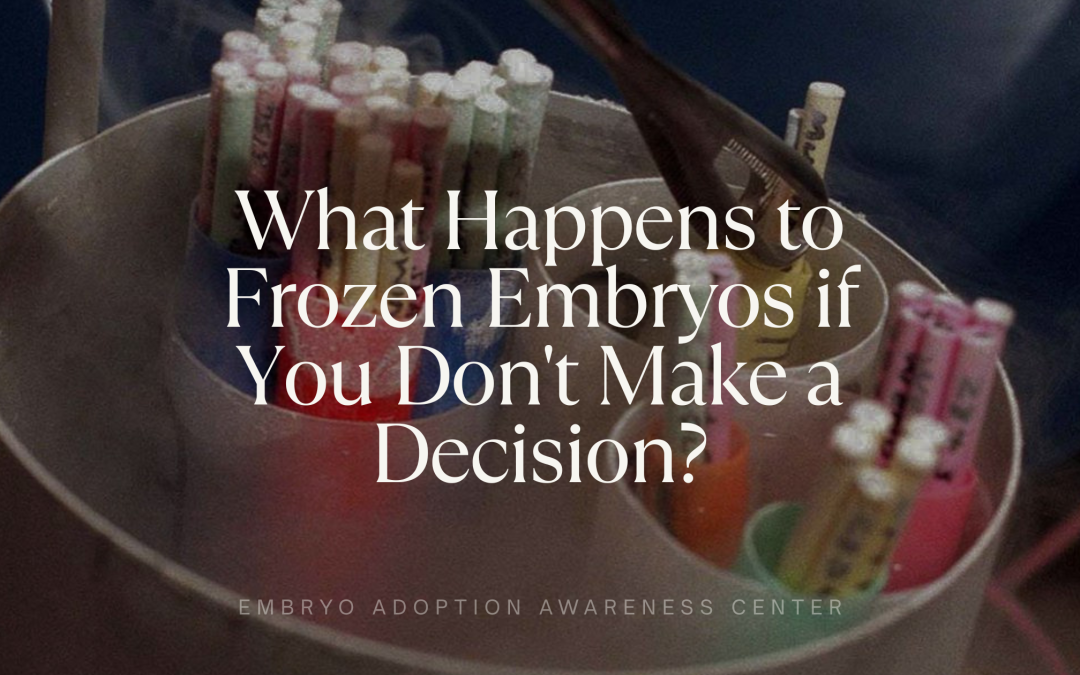
For many families, creating embryos through in vitro fertilization was the beginning of a long-awaited dream. Each embryo represented hope and the desire to build a family.
But after treatment is complete and your family has grown, many people find themselves facing a difficult question they never expected: “What should we do with our remaining frozen embryos?”
If you have been putting off that decision, you are not alone.
Thousands of families continue to store frozen embryos for years because they are not ready to decide what comes next. There is no timeline for processing the emotions involved, and many people find themselves with uncertainty about the future and the embryos they helped create.
Is It Okay to Wait?
Yes… to an extent.
It is completely understandable and normal to need time to decide on your next steps. Many families keep embryos in storage because they are still considering whether they might have another child. Others simply do not feel emotionally ready to explore the available options. Some avoid planning because every choice feels significant.
Taking time to thoughtfully consider your options is healthy. However, waiting indefinitely can create additional challenges and, sometimes, impossible hurdles.
What Happens When Embryos Stay in Storage?
Frozen embryos can remain cryopreserved for many years when properly stored. Advances in cryopreservation have made long-term storage remarkably successful, and healthy babies have been born from embryos frozen for decades.
While the embryos themselves can remain safely stored, life outside the storage tank continues to change.
Over time, families may:
- Continue paying annual storage fees.
- Move states or change contact information.
- Lose track of paperwork or storage facility communications.
- Find that making the decision feels even more difficult as the years pass.
Some clinics have policies regarding abandoned embryos if they are unable to reach patients after repeated attempts. Requirements vary by clinic and state, making it important to keep your contact information current and remain familiar with your storage agreement.
Additionally, assisted reproductive technology can change drastically over a short amount of time, making the option to undergo another transfer with the frozen embryos or donate the embryos for reproduction much more difficult than it otherwise would have been.
Understanding Your Options
When you are ready, there are several paths you may consider:
Continue Storing
If you are not ready to decide, the only option available to you is the continue paying for storage for your embryos. Many families appreciate having additional time to reflect without feeling rushed; however, the longer the embryos are in storage, the more difficult it may be to come to a decision about their future.
Use the Embryos to Grow Your Family
If you hope to have another child and your circumstances allow, using your remaining embryos to grow your family may be the right choice. For many families, this is the most streamlined option, as it does not involve transferring ownership or making decisions about the embryos’ future outside of their own genetic family.
Place with an Adoptive Family
More and more families are finding peace in knowing their embryos may give another family the opportunity to experience pregnancy and welcome a child into their family.
Embryo adoption allows the embryos to have the opportunity for life while also offering hope to intended parents who may not otherwise be able to grow their family. Every embryo adoption and donation program is different, and many allow placing families to choose the level of openness and communication between parties that feels most comfortable for everyone involved.
Donate for Scientific Research or Discarding
Discarding may be the only available option set forth by your fertility clinic if your embryos have been tested to be abnormal through PGT-A (aneuploidy). Many clinics have policies against transferring, donating, receiving, or transporting out aneuploid embryos. This news can be devastating for families who put all their love, finances, and emotions into the IVF process. As an alternative, Sacred Heart Guardians offers a burial service for embryos that cannot be used for family building or to place with an adoptive family.
The decision about your frozen embryos is deeply personal. It involves practical considerations, emotional experiences, personal values, and often faith.
It is normal for partners to process these decisions differently or to need different amounts of time before feeling ready to move forward. Honest conversations and asking questions can help bring clarity over time.
Whatever path you ultimately choose, making an informed decision is often less overwhelming than carrying the uncertainty indefinitely.
And it is important to remember that you do not have to figure it out alone.
If you are beginning to think about the future of your frozen embryos, start by learning about each option. Speak with your fertility clinic, ask questions, and explore the resources available to you.
If embryo donation is something you would like to understand better, we are able provide educational information about the process, what to expect, and how families can make decisions that align with their values.
No matter where you are in your journey, know this: taking the first step does not mean you have to make a decision today. It simply means giving yourself the opportunity to understand your options so that, when you are ready, you can move forward with confidence and peace.
To learn more about embryo donation and adoption, visit EmbyroAdoption.org.
Recent Comments